How Go atomic operations avoid race conditions?

Introduction
This question popped up in my head, "How Go atomic operations avoid race conditions?"
I finally gathered the courage to open the cloned Go Github repo and scan through it.
Go Code Structure
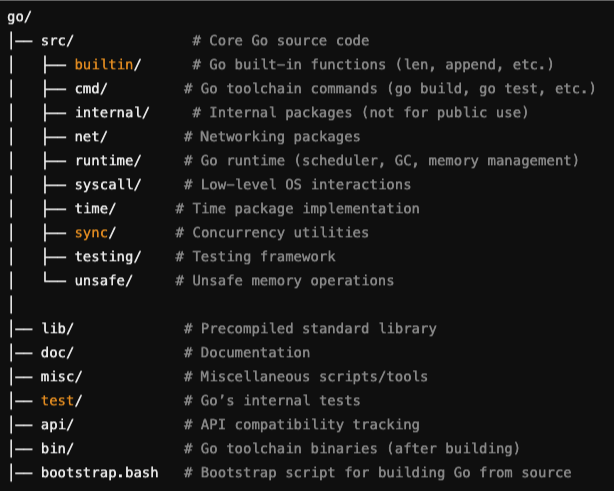
Source: ChatGPT
I went inside the implementation of CompareAndSwapInt32 and found this:
// CompareAndSwapInt32 executes the compare-and-swap operation for an int32 value.
// Consider using the more ergonomic and less error-prone [Int32.CompareAndSwap] instead.
//
//go:noescape
func CompareAndSwapInt32(addr *int32, old, new int32) (swapped bool)
Finding the implementation of this was not straightforward, because this method is implemented in Go Assembly:
TEXT ·CompareAndSwapInt32(SB),NOSPLIT,$0
	JMP	internal∕runtime∕atomic·Cas(SB)
What's Go Assembly?
Simply put, Go Assembly is the low-level language used to write performance-critical functions in Go. Go Assembler (Code directory path: cmd/asm) is the tool that compiles Go assembly (.s) files into machine code. The Go assembler was heavily inspired by the Plan 9 C compilers.
Plan 9 C compilers (6c, 8c, 5c, etc.) were architecture-specific compilers designed to generate optimized code for different CPU architectures. Unlike GCC or LLVM, which support multiple architectures within a single compiler framework, Plan 9 used separate compilers for different instruction sets. These compilers were originally developed for the Plan 9 operating system, an experimental OS designed as a potential successor to Unix-based systems.
You can read more about it here: https://9p.io/sys/doc/compiler.html
Go drew inspiration from 9 C Compiler:
- Just like Plan 9 had separate compilers for different architectures (e.g., 6c for x86-64, 8c for ARM, etc.).
- Go’s assembler follows a similar architecture-based approach, instead of a universal assembler Go has different assemblers for x86, ARM, RISC-V, etc.
You can watch this, an interesting talk about Go Assembler presented by Rob Pike himself.
Go Assembler streamlined a lot of things:
- Portability: It abstracts CPU architecture details better.
- Simpler syntax: No need for % prefixes, brackets, or complex addressing.
- Unified across architectures: ARM, AMD64, RISC-V, etc., use the same structure.
- Designed for the Go runtime: Helps implement Go features like garbage collection, goroutines, and stack growth efficiently.
Go Assembler has 4 architecture-specific implementations of atomic.CompareAndSwapInt32():
- amd64.s: For AMD64 (x86-64) architecture (Intel, AMD CPUs).
- arm64.s: For ARM64 (AArch64) processors (used in Apple M1/M2, mobile devices, servers).
- ppc64le.s: For PowerPC 64-bit, Little Endian (used in IBM systems).
- s390x.s: For IBM Z-series mainframes (used in enterprise computing).
Go runs on multiple architectures, and low-level atomic operations must be natively implemented for each to ensure compatibility.
Added the implementations for one architecture (other 3 are similar) in Go Assembly:
// bool Cas(int32 *val, int32 old, int32 new)
// Atomically:
//	if(*val == old){
//		*val = new;
//		return 1;
//	} else
//		return 0;
//  }
TEXT ·Cas(SB),NOSPLIT,$0-17
	MOVQ	ptr+0(FP), BX
	MOVL	old+8(FP), AX
	MOVL	new+12(FP), CX
	LOCK
	CMPXCHGL	CX, 0(BX)
	SETEQ	ret+16(FP)
	RET
Explaining this line by line how this maintains atomicity.
TEXT ·Cas(SB),NOSPLIT,$0-17
TEXT ·Cas(SB): Declares the function Cas(CompareAndSwap) in Go assembly.NOSPLIT: Instructs the runtime not to perform stack splitting, ensuring that the function runs without interruption. It tells the Go runtime not to perform stack splitting for that function.$0-17:Specifies the stack frame size for the function (0 bytes for local variables and 17 bytes for arguments/return values).
MOVQ ptr+0(FP), BX:
- Moves the pointer
ptr(the address of val) from the function's frame pointer (FP) into theBXregister.
MOVL old+8(FP), AX:
- Moves the old value from the frame pointer into the
AXregister.
MOVL new+12(FP), CX:
- Moves the new value from the frame pointer into the
CXregister.
LOCK:
- This is a crucial instruction. It prefixes the next instruction (CMPXCHGL) with a lock, ensuring that the memory operation is atomic. This lock ensures that no other process or thread can modify the memory location while the compare and exchange instruction is running.
CMPXCHGL CX, 0(BX):
- This is the Compare and Exchange instruction. It performs the following:
- Compares the value in AX (the old value) with the value at the memory location pointed to by BX (the val value).
- If the values are equal, it replaces the value at 0(BX) with the value in CX (the new value).
- The original value at 0(BX) is loaded into the AX register.
SETEQ ret+16(FP):
- SETEQ sets the byte at the destination to 1 if the zero flag is set, and to 0 otherwise. In this case, it sets the return value to 1 if the comparison was equal (meaning the swap was successful), and to 0 otherwise.
RET:
- Returns from the function
Conclusion
At the register level, atomicity is achieved because:
- The LOCK prefix serializes access across CPU cores.
- CMPXCHGL ensures all three steps (compare, swap, write-back) happen as one unit.
- The CPU guarantees atomicity, eliminating race conditions without software locks.
Feel free to be curious and figure out the answers to your questions on your own.